

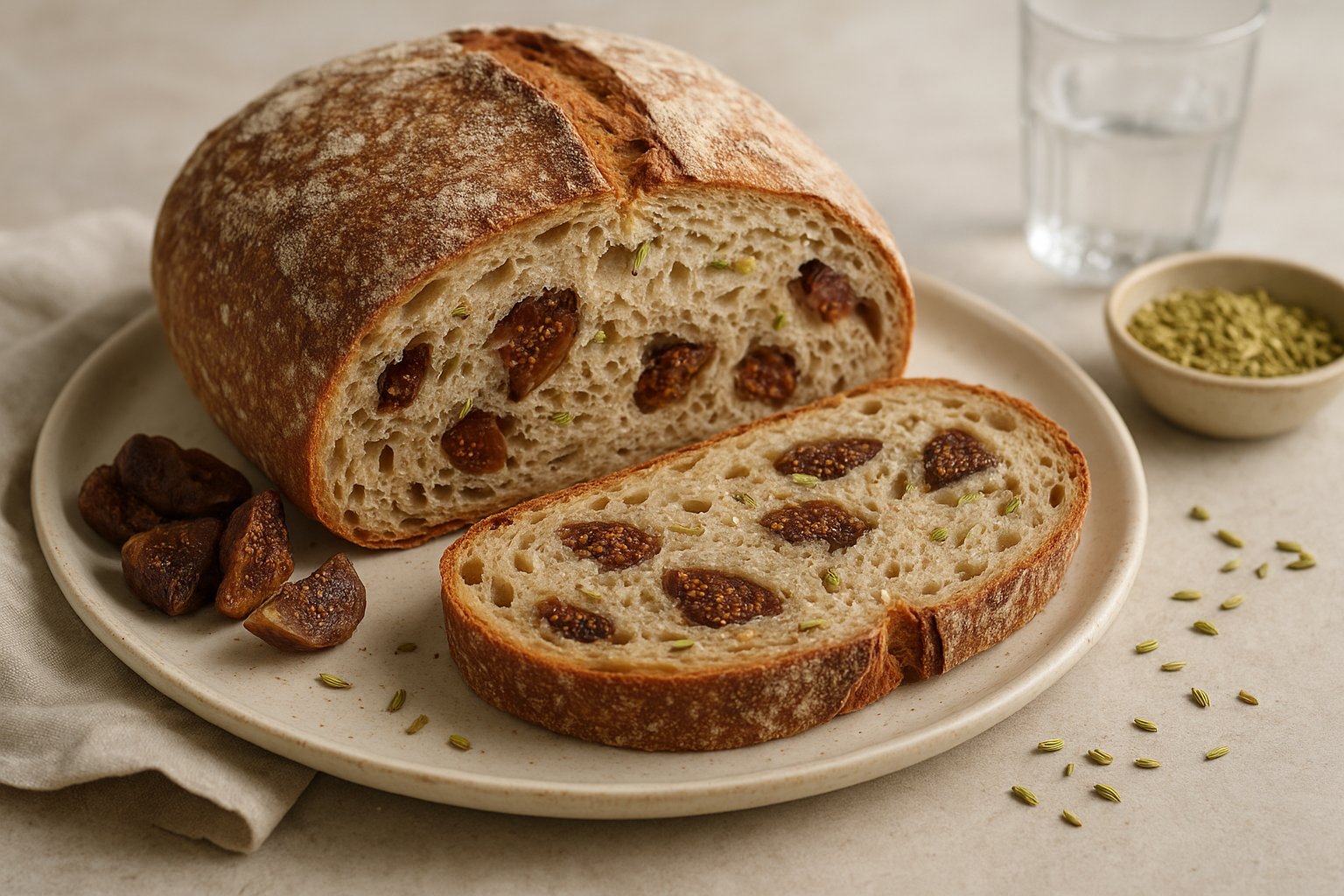
Fig And Fennel Sourdough
30m prep 30m cook 1h 0m ready
A hearty sourdough bread studded with dried figs and green fennel seeds, offering a sweet and aromatic flavor. The dough combines white and wholemeal bread flour for a rustic texture.
Nutrition (per serving, estimated)
Estimated based off 7 of 9 identified ingredients (per 100 g food data, scaled by amount).
Vitamins & minerals
- Calcium: 520 mg
- Iron: 27.4 mg
- Magnesium: 390 mg
- Phosphorus: 878 mg
- Potassium: 2038 mg
- Zinc: 7.46 mg
Let's Prepare
Collect
Gather these ingredients - no prep needed yet.
- 100 g white sourdough starter
- 75 g white bread flour
- 75 g water
- 350 g white bread flour
- 150 g wholemeal/wholewheat bread flour
- 300 g water
- 10 g green fennel seeds
- 10 g fine/table salt
Prepare
- Quarter 175 g dried figs
Let's Cook
-
Step 1.
Mix the pre-ferment ingredients (100g white sourdough starter, 75g white bread flour, 75g water) together thoroughly in a bowl. Cover with a damp cloth or plastic wrap and leave at room temperature for 12–14 hours, typically overnight, until bubbly and active.
-
Step 2.
Add both flours (350g white bread flour, 150g wholemeal bread flour), 300g water, and 10g green fennel seeds to the pre-ferment. Mix thoroughly until no dry flour remains. Cover and let rest at room temperature for 20–30 minutes (autolyse).
-
Step 3.
Sprinkle 10g salt over the dough and knead for a few minutes until the salt is fully incorporated and the dough becomes smooth and elastic. Cover and rest at room temperature for another 30 minutes.
-
Step 4.
Turn the dough out onto a lightly floured work surface. Using a rolling pin, roll it into a rectangle about 1 cm thick. Distribute 175g quartered dried figs evenly over half of the dough. Fold the other half over the figs, pressing the edges to seal. Roll the dough out again into a rectangle, fold in half, and roll out once more. If figs are not evenly distributed, repeat the rolling and folding process, being careful not to mush the figs completely.
-
Step 5.
Shape the dough into a ball by tucking the edges underneath. Place in a lightly floured bowl, cover, and let prove at room temperature for 1 hour.
-
Step 6.
Give the dough a single fold: gently stretch one side and fold it over the center, then repeat on the opposite side, and finally fold the top and bottom. Cover and let prove for another 2 hours, or until almost doubled in size.
-
Step 7.
Dust a proving basket (banneton) generously with flour. Turn the dough out onto a lightly floured surface and shape it into a tight round or oval to fit the basket. Place seam-side up in the basket, cover, and let prove at room temperature for 1 hour.
-
Step 8.
Place a baking stone or inverted baking sheet in the oven and preheat to 230°C/210°C fan/450°F/gas 8. Carefully turn the proved dough out onto a floured peel or parchment paper. Slide it onto the hot baking stone. Bake for 10 minutes, then reduce the oven temperature to 200°C/180°C fan/400°F/gas 6 and bake for another 20 minutes. Check halfway through; if the loaf is browning too quickly, tent loosely with foil. The bread is done when it sounds hollow when tapped on the bottom. Transfer to a wire rack and cool completely before slicing.
Ratings & reviews
Have you made this? Take a moment and let us know what you think. Sign in to leave a rating.